Table of contents
I’m sure I’m not the only one who’s felt this way. I first tried to be a perfect minimalist. I cleared out my closets and felt wonderfully light. Then, I decided I needed to save the planet and swung hard into Zero Waste. Suddenly, my tidy, empty space was cluttered again—but this time with jars, bulk bags, bamboo everything, and silicone pouches. It was exhausting! I was trying to do both and ended up feeling overwhelmed, stressed, and even judged myself for not being ‘good enough’ at either one.
Sound familiar? If you’re juggling a career, family, and trying to ‘do the right thing’ by the planet, you’re not alone. We’re in our 40s or beyond; we’re busy. We don’t have endless hours to shop at three different stores just to save one plastic bag, nor do we want to throw away something perfectly good just to adhere to a strict aesthetic. We need practical, budget-friendly routines that actually make our lives better, not harder.
The truth is, while they seem similar, they come from different places. Minimalism is about managing your inflow (what you own) for mental peace. Zero Waste is about managing your outflow (your trash) for environmental health. I realized the only way to succeed was to stop treating them like two separate, mandatory lists and combine them into a simple, flexible routine.
Here are the three simple rules I finally settled on that helped me find the sweet spot.
Just a friendly reminder: This article isn’t environmental policy or professional organizing advice. It’s just me sharing my personal journey and routine. Your home, your rules!
Rule 1: Prioritize the “Why”—Where’s Your Biggest Problem?
When I started out, I’d panic over a single plastic wrapper. I’d rush out to buy the ‘sustainable’ replacement for every single thing, from the dishwasher brush to the cotton rounds. But I started reading up, and the people who really study sustainability often say: “Don’t focus on everything. Focus on the biggest, easiest wins first.” They call it the 80/20 rule of waste.
This is where the money-saving aspect comes in, which is huge for us busy people. By prioritizing Zero Waste efforts on the biggest source of waste in my home, I immediately saw savings. My biggest trash source was food packaging, especially individually wrapped snacks and takeout containers.
My action: I cut out pre-packaged snacks entirely and switched to making big batches of granola or muffins on Sundays. I now buy flour, nuts, and oats in bulk at my local store, bringing my own reusable bags.
Why this works: Not only did I eliminate a huge volume of plastic trash, but I also significantly lowered my weekly grocery bill. Those convenience items add up quickly! I did a quick calculation to make myself feel better about the effort: before, I was spending about $15 a week on pre-packaged snacks for the family. Now, buying bulk ingredients costs me maybe $6 a week for the same output. That’s about $9 in savings per week, which is over $460 a year. (Of course, I still buy treats sometimes, so realistically, I’ve saved at least $150 a year, easy.) That’s a Minimalism win (less clutter in the pantry) and a Zero Waste win (less plastic) thanks to an Economics choice.

Rule 2: If the ‘Eco’ Version Adds Mental Clutter, Get Rid of It!
One of the most important lessons I learned was that sometimes, the “eco-friendly” alternative is just a fancy new piece of clutter.
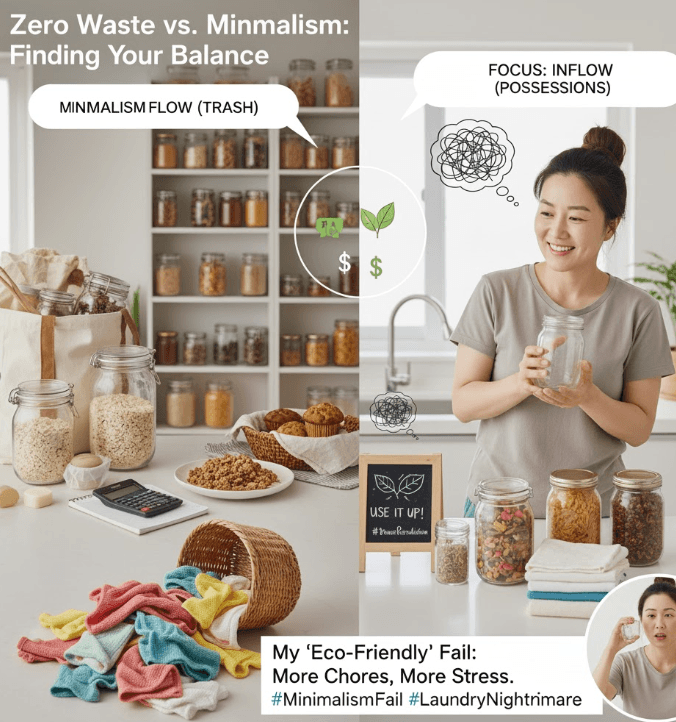
I had this honest moment of failure with reusable paper towels. I bought a pack of beautiful, colorful cotton cloths. They were a perfect Zero Waste swap! But every time I wiped a spill, they ended up in a messy pile, waiting for a separate laundry cycle. My laundry routine became a nightmare, and the cloths piled up, adding more visual clutter and more work. I felt so guilty.
I realized I was violating the core Minimalist principle: reducing mental load.
At this age, we don’t have the energy for complicated systems that add chores. If a new habit adds mental load, it’s out—no guilt. We are prioritizing peace over perfection.
My action: I gave them away. Instead, I went back to using old, cut-up cotton t-shirts and worn-out bath towels as cleaning rags. They’re technically ‘Zero Waste’ because I’m giving them a second life before they hit the trash, and they’re Minimalist because they didn’t cost me any new money or add a new, complicated chore.
The logical reason: Minimalism is about reducing your cognitive burden, and if a Zero Waste item makes your daily routine too complicated, you won’t stick with it. I heard a seasoned organizer say that “the most sustainable choice is the one you will actually use and maintain.” Using an existing item—an old T-shirt—before it’s tossed is often a better environmental choice than buying a new “eco” product that just adds clutter.
Rule 3: Use What You Have First (Practicality & Budget)
When I was in my early 40s, I had a huge, half-used container of plastic food wrap and dozens of Ziploc bags under the sink. My first instinct, driven by the Zero Waste movement, was to throw them all out immediately and buy glass containers and silicone bags.
That would have been terrible! Throwing away usable plastic just to buy more new items (even sustainable ones) is neither economical nor environmentally sound.
My action: I made a strict rule. I had to use up every last plastic bag and piece of wrap I owned before I allowed myself to buy the silicone replacements. It took almost eight months, but it saved me from wasting money on items I didn’t need yet and delayed the carbon cost of buying new stuff.
Practicality & Extended Tips:
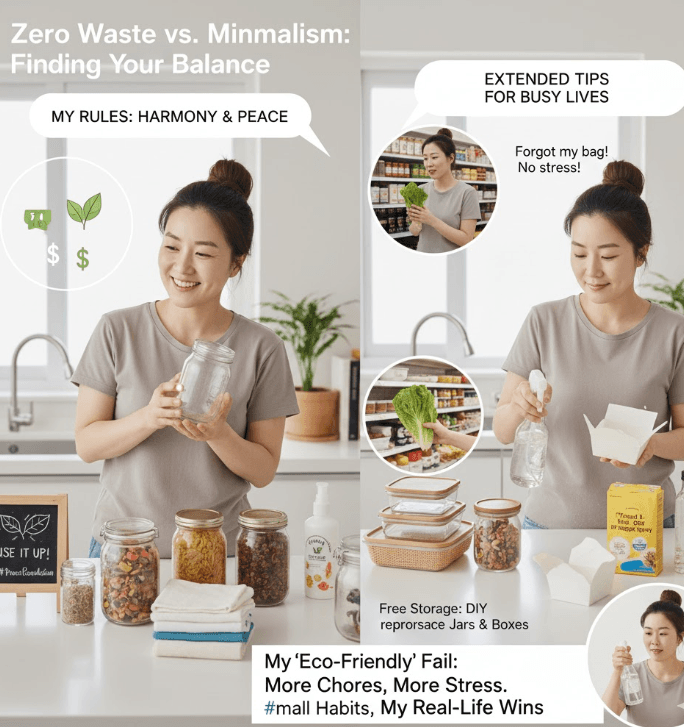
- Forgetting Your Bag? We all forget the reusable bag sometimes! Instead of buying a new one, just carry the item by hand or politely ask the cashier if they have an empty box you could use. Don’t stress or buy a plastic one; it’s a small redirection, not a failure.
- Budget Swaps: If you’re running low on a cleaning product, try making a simple multipurpose cleaner from vinegar and baking soda. The ingredients are cheap, often sold in bulk, and replace at least three separate plastic bottles. It’s an easy win for your wallet and the planet.
- The Power of Repurposing: When a jar of jam or pickles is empty, simply wash it and keep the lid. Congratulations, you just created a free, Zero Waste container for leftovers, spices, or bulk goods!
It’s not about perfection; it’s about making a choice. My routine is no longer about following two separate, difficult lists. It’s about asking myself if a choice will reduce my waste (Zero Waste) and simplify my life (Minimalism). When both answers are yes, I know I’ve found the right habit.
And honestly? My home is calmer, my wallet is fuller, and I sleep better knowing I’m doing what I can—without burning out.





2 thoughts on “Zero Waste & Minimalism: My 3 Rules for Effortless Blending”