
I’m sharing a personal journey here. This post is not medical advice or professional financial counseling. It’s just an honest account of my own experiences and the routines I use.
A few years ago, I hit a wall. It wasn’t the kind of burnout that stops you from working. It was the crushing, quiet exhaustion of waste guilt. I’d get home from the grocery store, and the sight of four new plastic bags and mountains of clamshell packaging would just deflate me. I felt powerless. I felt like a contributor to a system I didn’t believe in. One Tuesday, I spent 20 minutes standing by the cart return, mentally re-bagging my haul into the forgotten reusable bags in my trunk. I realized my frustration was costing me time, money, and peace of mind. That constant anxiety was impacting my time and my wallet. Ultimately, this stress was draining my peace of mind.
I didn’t want to be a “zero-waste expert.” In truth, I just wanted a simpler life with less junk. Therefore, the solution wasn’t about making grand gestures; instead, it came down to three simple, almost automatic routines. These routines took the willpower out of the equation and, consequently, brought me a surprising amount of financial relief. Ultimately, my burnout came from trying to be perfect, especially with my single-use plastics. However, the three habits that changed everything were small, simple changes to my shopping, my kitchen, and my mindset.
My Shopping Rule: Never Leave the Car Without My “Trunk Toolkit”
The biggest problem wasn’t that I didn’t own reusable bags. Instead, the issue was that they were always sitting neatly on a hook at home when I needed them most. Consequently, I’d walk into the grocery store for a quick item, realize I needed a bag, and then pay the $0.10 fee for a paper or emergency plastic one. In fact, I used to spend $2 to $5 on those last-minute bags every single week. Therefore, that’s $100 to $260 a year just on forgetting things!
How I Fixed It
My solution was to create a permanent Trunk Toolkit. Specifically, I now keep four large, sturdy shopping bags, two mesh produce bags for fruits and veggies, and two empty mason jars for deli counter meats or nuts, all stored in one designated box in the trunk. Crucially, the rule is simple: The box lives permanently in the trunk. It never comes inside the house unless I’m doing laundry. As a result, this eliminated the mental checklist before every single trip. Ultimately, the bags are just there.
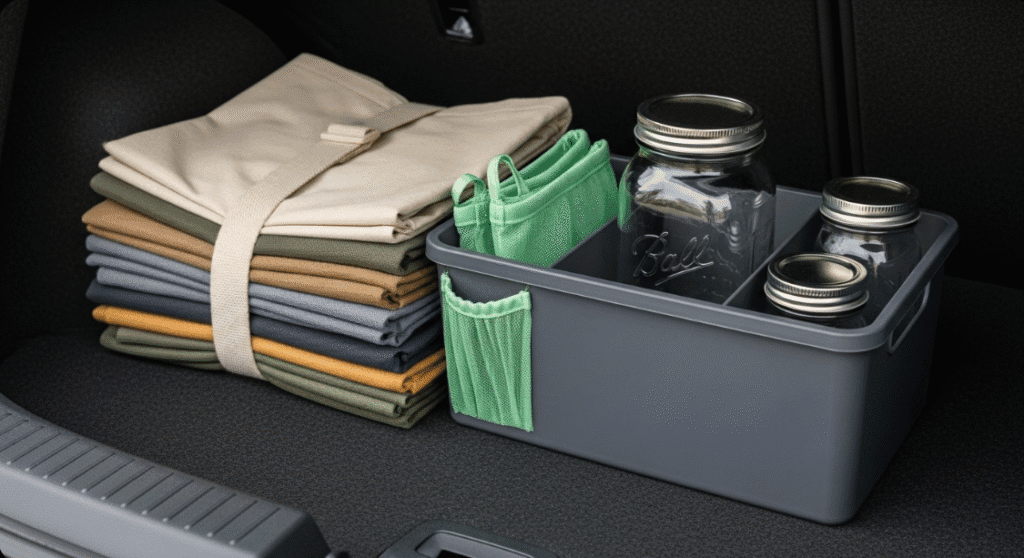
This simple habit also curbed my impulse spending. Before I started using the toolkit, I’d often run in for milk and walk out with three unnecessary items that didn’t fit in my arms. Those spur-of-the-moment purchases easily added up to $20 to $40 a week. Why does this work? It’s simple: The lack of convenience forces you to be mindful. If you have to remember your jars, you are more likely to stick to your list.
The Real Cost Savings
I calculated my change over a six-month period. Before, I’d spend about $160 a month on impulse items and emergency bags. Now, by carrying the toolkit and sticking to a list, that spending is down to about $55 a month. I save $105 every month. It’s not just about the plastic; it’s about making your money work for you.
My simple rule is this: Keep the tools closer to the action than the front door.
Next, I had to figure out how to stop the flood of tiny plastic containers from entering my house in the first place.
My Kitchen Rule: Buy Big and Skip the Single-Serve Guilt
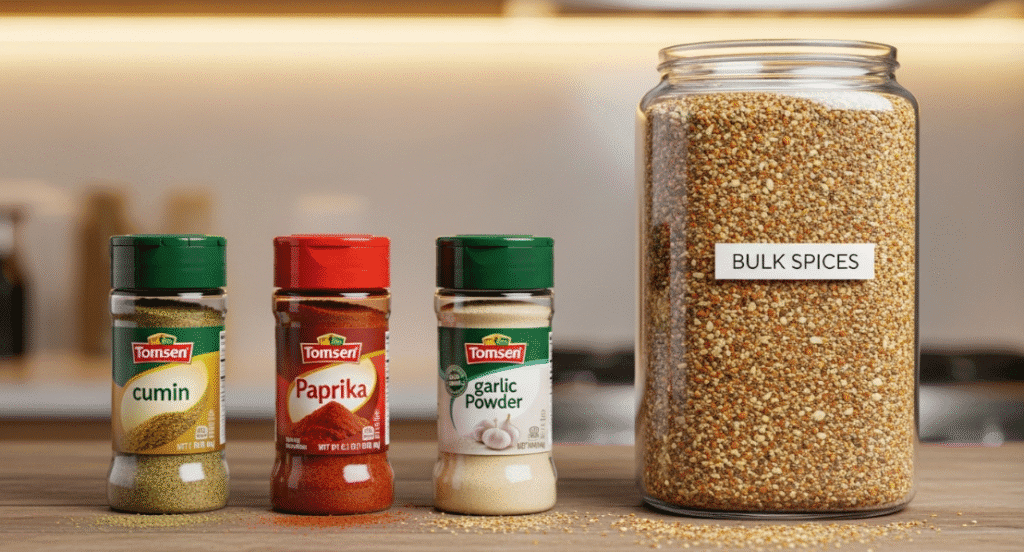
I used to love the convenience of tiny spice jars, small bags of oats, and individually wrapped snack bars. But the environmental cost, and especially the financial cost, was enormous. Once, I lined up all my half-empty, identical spice jars—I had three jars of cinnamon! I realized I was buying small jars frequently and wasting money on packaging.
How I Fixed It
I decided to Buy Big. Finding a local co-op with a robust bulk section was my first step. This allowed me to buy large, six-month supplies of staples like rolled oats, kidney beans, and all-purpose flour. I even started taking my own reusable container to fill with dish soap and laundry detergent. This works because the unit cost of bulk items is drastically lower. More importantly, it forces me to plan my meals ahead of time, which dramatically cuts down on impulsive takeout orders or last-minute, over-packaged convenience meals. This makes bulk buying a huge time-saver in the long run.
This approach gave me control. I wasn’t relying on a distant recycling plant to process complex packaging. I was simply not bringing them home. It was a direct, satisfying solution. You become the solution. This also saves me time and confusion avoiding the recycling aisle and sorting different types of plastics. Did you know that individuals can achieve significant cost savings, sometimes over $5,000 annually, just by embracing simple reusable items and bulk shopping? This approach really proves that progress is better than perfection, as shared by many zero-waste advocates. You can read more about how small steps truly add up on the National Geographic website, which provides excellent context on this lifestyle.
The Real Cost Savings
A tiny jar of organic spices can cost $4.99 and hold maybe 1 ounce. I can buy that same quantity in bulk for less than $1. Looking at my quarterly spending, I realized I used to spend an average of $60 every three months replacing small staples. By shifting to bulk, that expense dropped to about $15 to $20. I saved roughly $180 to $200 per year just on five basic pantry items. Quarterly Savings: ~$45 (or $15 per month).
It turns out that making these physical changes was only half the battle. The real work was in changing the voice inside my head.
My Mindset Rule: Focus on Three Wins, Not a Perfect Zero
The biggest barrier to sustainable living is the pressure to be perfect. You see families on social media who fit all their annual trash into one mason jar, and it makes you feel like a failure. I spent my first two weeks of this journey feeling defeated every time I accepted a receipt or bought something packaged.

How I Fixed It
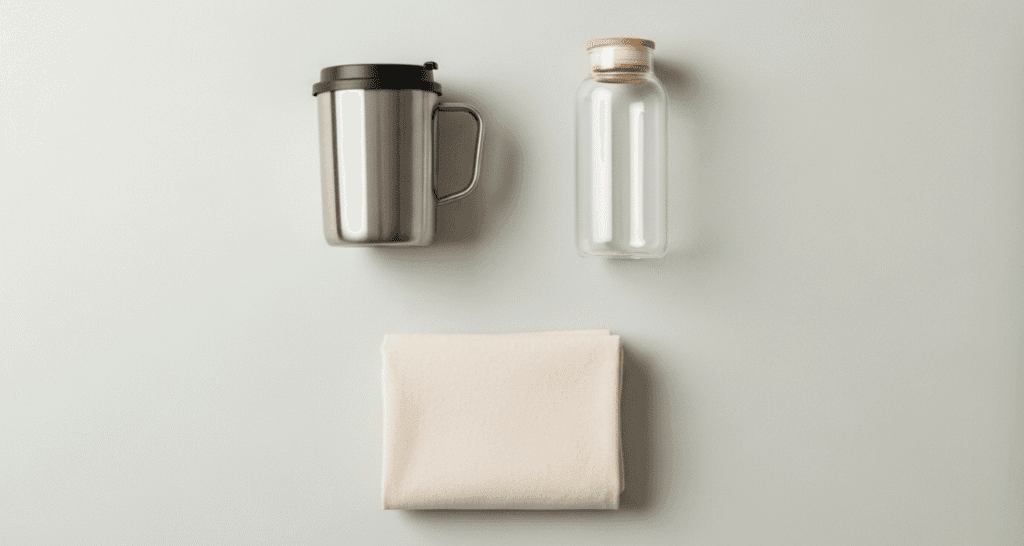
I stopped striving for “zero waste” and started chasing three wins. My three easy wins are: 1. My Coffee Cup. 2. My Shopping Bag. 3. My Water Bottle. That’s it. If I achieve those three things on any given day, I consider it a successful day, no matter what other accidental trash I create. This shift is vital because the system we live in—from government subsidies to packaging design—is often built to generate waste. You shouldn’t feel guilty for every single item you use. You can only control your habits.
This approach gives you realistic goals. Why is this better than the old perfectionist goal? It acknowledges that true, large-scale waste reduction requires policy and infrastructure changes, like structural changes in some communities. By focusing on your three wins, you channel your energy into where you have 100% control, leading to less guilt and more consistency.
The Emotional Payoff
Before this mindset shift, a single lapse would derail my entire week. I’d think, “Well, I forgot my coffee cup, so I might as well forget my shopping bags too.” Now, I can forget my coffee cup and still feel good about using my shopping bag. The real saving here is mental energy. I’m no longer emotionally drained by the “all or nothing” cycle. I save myself hours of internal judgment every month, and that’s priceless.
A New Kind of Simple
The process of cutting down on single-use items doesn’t have to feel like a revolutionary act. For me, it became a simple, repetitive routine that actually added value to my life through tangible savings ($120 a month total) and a huge drop in internal stress. The focus isn’t on the dramatic headline; it’s on the quiet, consistent act of carrying your own stuff.
If you’re feeling overwhelmed, don’t try to change your entire lifestyle tomorrow. Just try one thing. I suggest you put four large shopping bags in your car right now. Then, the next time you go shopping, try to use them. See what happens. Two weeks from now, check your credit card statement and see if you noticed a difference. If you do, come back and let me know how much you saved in the comments. I’d love to hear your first win!
[Read More]






1 thought on “The Simple Switch That Saved Me Over $100 a Month and Cut My Trash”